From the Depths vs Space Engineers
See how two games stack up across what matters most to you.
Short answer
They fill different engineering fantasies: From the Depths is a component-level combat sandbox where every shell, engine, and cannon matters in naval battles, while Space Engineers is a structural sandbox where ships, stations, and planets form a persistent world. If you crave intricate combat and custom ammo, choose From the Depths; if you prefer structural integrity and multiplayer world-building, choose Space Engineers. Neither is universally better; pick the dissertation topic that matches your building obsession.

Side-by-side Comparison
From the DepthsSpace Engineersimportance
Weapons versus worlds
The fork between these two sandboxes is not about who builds bigger or flies higher. From the Depths treats the vehicle as a concentration of systems—each cannon, shell, and engine is a decision that decides a battle. The campaign maps give that engineering a purpose: your fleet sails an open theater, and every design is tested in combat that is resolved by the parts you chose.
Space Engineers, by contrast, treats the vehicle as a skeleton that must hold together against physics. A ship is a lattice of blocks, and the moment you lift off, thrust math becomes homework; every joint and surface bears a structural load. One game asks how your creation fights, the other asks how it stands.
That is the decisive tension: one is a CAD suite with cannons, the other a hard-vacuum framework where flying is the achievement. Builders ready to go beyond blocks will feel this immediately—the former rewards tactical internal design, the latter rewards architectural honesty. Neither vision is shallow, but they point in opposite directions: one inward toward simulated ammunition and armor, the other outward toward a persistent world you can occupy. Your choice is a statement about whether you want to master a machine or inhabit a place.
When the blueprint is the battle
Choose From the Depths if your idea of a sandbox is a laboratory where combat is the final exam. The record describes component-true warships and custom ammunition design—you are not merely placing a turret, you are tuning the shell's payload, its fuse, its flight characteristics, until the weapon feels like your signature. That depth is the entire point: battles are engineering-decided, meaning the best drawer wins.
The faction campaign maps give you a reason to build, a sequence of opponents that force you to iterate; co-op lets you share that obsession and wage wars with friends. If you are comfortable living inside a spreadsheet, if the thought of designing a belt feeder for a 500mm cannon makes you grin, this is your dissertation topic. The learning curve is steep—it is a CAD suite with cannons—but the reward is a warship that behaves exactly as you intended, down to the last fuse.
You are not building for wanderlust; you are building for war, and every block has a combat function. This is the sandbox for the engineer who believes a weapon's soul is its internals.
When the structure is the story
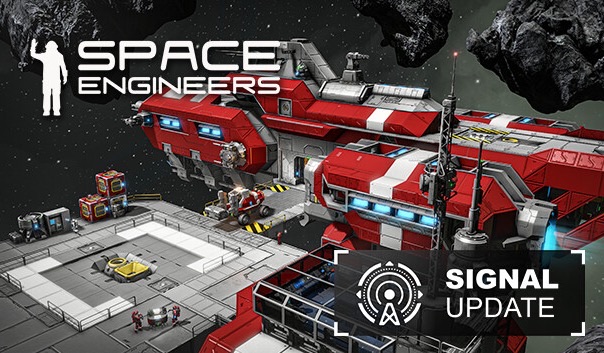
Choose Space Engineers if your imagination runs to structures rather than ordnance. Here the record points to structural physics integrity—your ship must survive its own weight and thrust, and that requirement shapes every creative decision. The scope reaches planets and deep space, giving you a canvas that spans worlds; exploration is a real freedom, not just a backdrop. Multiplayer is the heart: persistent servers where factions collaborate on shared builds, each carrier or station a joint project that stands because of its architecture.
The game does not hand you a war to fight; it hands you a vacuum and says make it yours. Scenario framing is light, but the world immersion is deep—hard-vacuum verisimilitude makes every launch feel like a real flight, and every docking a small triumph. The learning curve is firm: thrust math is homework, but the lesson is structural honesty, not combat tactics. If you love the idea of a base that must be pressurized, a miner that must not shear apart under load, and a skyline in orbit, this is your fit. You are building a planet-to-orbit universe, not a single weapon; your pride is in the assembly, not the ammunition.
Key facts, side by side
Playtime figures are community-reported estimates from HowLongToBeat (captured 2026-08-16), not main-story completion times.
Similar Games to Consider
Based on what you like in both games